

Ask a planner where the budget goes on a destination program and you’ll hear about the venue, the closing dinner, the offsite. Ask an attendee what they remember, and you’ll often hear something much smaller: the note waiting on the bed. The person at the airport holding a sign with their name spelled right. A cold drink handed over before they’d thought to ask for one.
Arrival is the first thirty minutes of a program that might run four days. It is almost never the line item anyone protects. And it is, reliably, where guests decide how they feel about the whole thing.
Why Arrival Carries So Much Weight
Your guests land tired. They’ve been in transit, often across time zones, frequently with a laptop bag and a garment bag and a phone at eleven percent. Whatever they’re feeling in that moment — cared for, or processed — becomes the baseline they carry into the first session.
That’s the practical argument for designing arrival deliberately. There’s a strategic one too: it’s the only moment in the program where every single attendee has the identical experience, at the same point in the story, before anything else has shaped their impression. Nowhere else do you get that.
The Handoff Points Worth Designing
A destination arrival isn’t one moment. It’s a sequence of small handoffs, and each one is either designed or left to chance.
Transfer and greeting. The airport pickup is the first branded surface most guests encounter. A well-made sign, a greeter who knows the agenda well enough to answer a question, a vehicle that isn’t a surprise — this sounds obvious, and it is the piece most often subcontracted without a second look.
Check-in. Hotel check-in is the natural friction point of any group program. Whether you use a dedicated group desk, pre-issued keys, or a welcome table in the lobby, the goal is the same: shorten the gap between arriving and being somewhere comfortable. Anything you hand a guest here should be genuinely useful in the next hour — a room key, a schedule card, directions to the welcome reception. Not a folder.
The room. The room drop is the quietest and most effective design opportunity in the program. A guest walks in alone, sets down their bag, and finds something waiting. Handled well, it’s the moment the program stops feeling corporate.
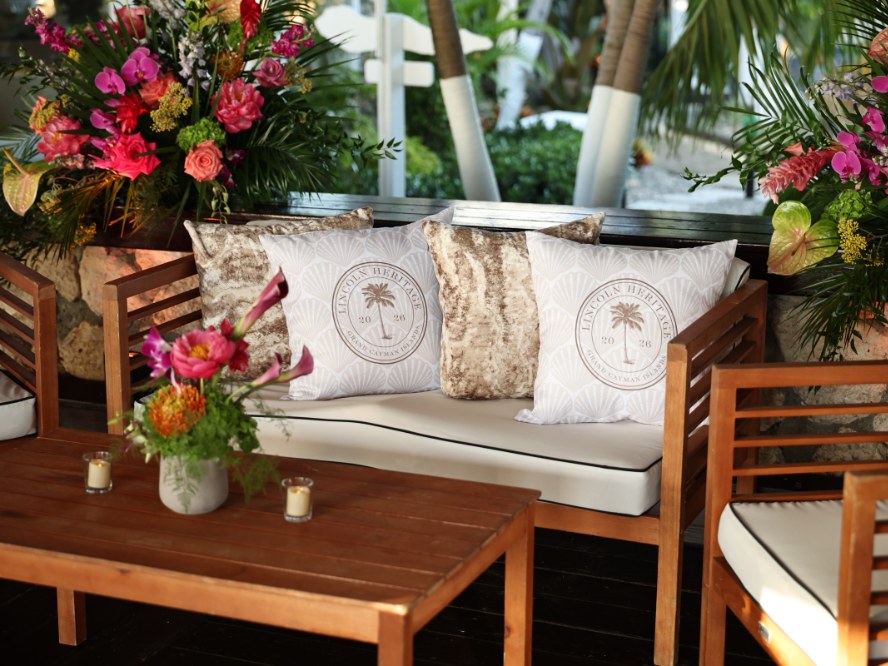
The first gathering. Whether it’s a reception, a dinner, or a casual hour on a terrace, the first gathering is where the group becomes a group. Signage, table design, and printed pieces do quiet work here — orienting people, making the space feel intentional rather than booked.
On Welcome Gifts
A word about the welcome bag, because it’s where good intentions most often go sideways.
The test is simple: would a guest carry this home in a suitcase they have to close? Most welcome bags fail that test. They’re full, they’re branded, and half of it ends up in the hotel wastebasket.
Fewer, better things travel home. One well-designed piece with a local connection beats six generic ones. And a handwritten card — or something that reads as handwritten — outperforms nearly anything you could put beside it. It’s the piece guests photograph.
The Design Layer
The thread running through all of this is consistency. Arrival is where a program’s visual identity either establishes itself or doesn’t.
When the airport signage, the schedule card, the room drop note, the reception menus, and the wayfinding all share a palette, a typeface, and a voice, guests don’t consciously register it — they simply experience the program as considered. When those pieces are assembled from five different sources, that reads too, just as unmistakably.
This is where destination management and design belong in the same conversation rather than in separate ones — the same principle behind building a seamless group experience from end to end. Logistics get people to the right place at the right time. Design tells them what kind of experience they’ve walked into.
Where to Start
If you’re building a program now, take the arrival sequence and write it out as a timeline — plane to room to first gathering — and mark every point where a guest receives something, reads something, or is greeted by someone.
Most planners find between six and ten touchpoints. Most programs have designed two or three of them.
The rest is where the opportunity is.
Let’s Talk
We’d love to hear about the program you’re planning and where your guests’ first thirty minutes could be doing more. Reach out at beinlovedesigns@gmail.com.